

A golf swing drill is a focused practice exercise that isolates a specific mechanical element of the swing—such as alignment, tempo, or weight transfer—to train the body and brain to reproduce a better movement pattern. Drills work by simplifying complex motions into repeatable cues that reinforce muscle memory, improving swing consistency, ball-striking, and distance control. This guide explains why targeted drills accelerate improvement, which drills to choose at each stage of development, and how apparel and lightweight training aids can support practice sessions. Readers will gain a progressive plan from beginner fundamentals to advanced power work, corrective strategies for slice and hook problems, and practical home-range drills that fit daily routines. The article also maps biomechanics to drills, offers product-to-drill apparel guidance, and answers common questions about practice frequency and measurable progress.
Beginner golfers benefit most from drills that simplify setup, tempo, and weight transfer so fundamentals become reliable under pressure. These foundational drills emphasize alignment for consistent path, tempo for repeatable rhythm, and weight transfer to generate power without tension. Practicing these three elements in short, focused sets builds a durable motor program that translates to better contact and straighter ball flight. The following subsections break each drill into setup, execution cues, common mistakes, and quick progressions to full swing work. After mastering these basics, beginners can layer in short-game and course-management practice with confidence.
The top three beginner drills to prioritize are:
These drills together establish a dependable foundation for all subsequent swing development and make more advanced power or corrective work effective.
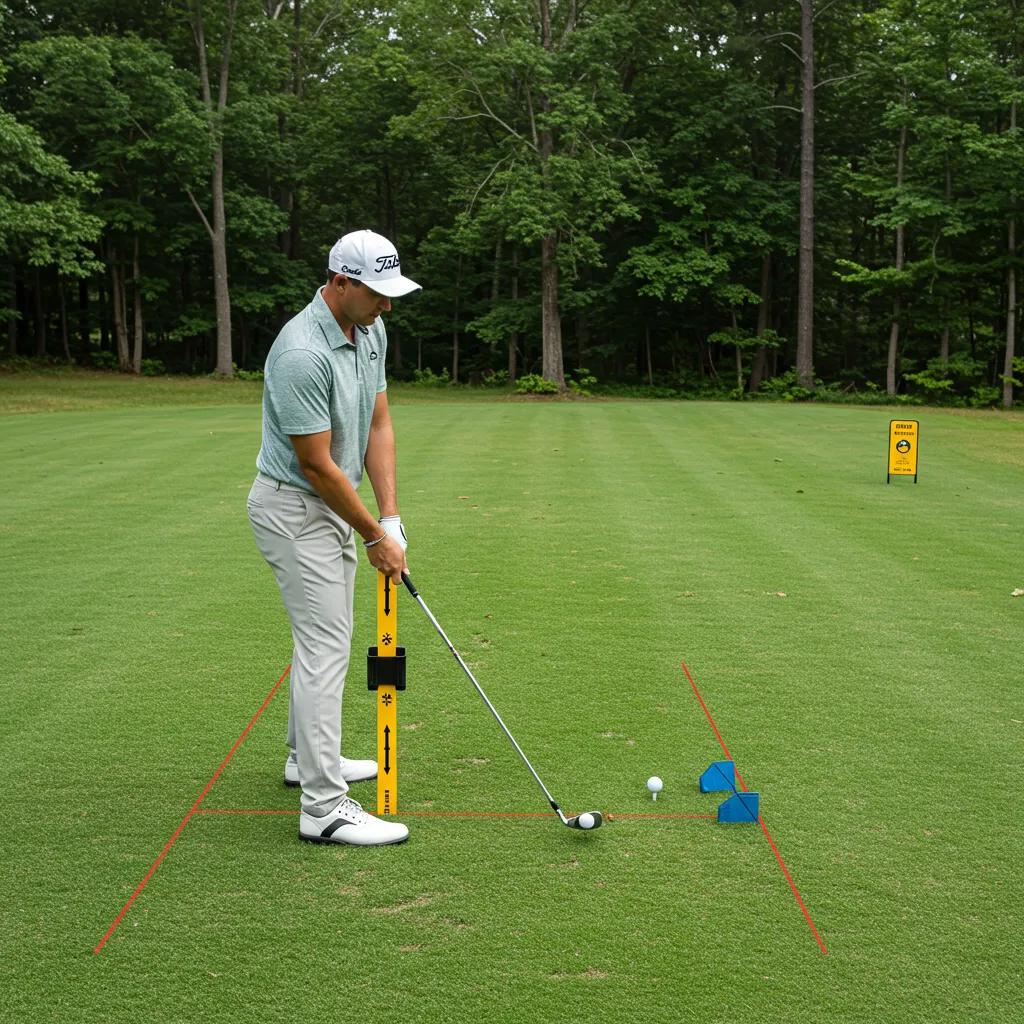
The alignment drill teaches correct setup by forcing consistent relationship among feet, hips, shoulders, and clubface; the mechanism is visual-motor feedback that reduces setup variability. To perform it, place an alignment stick or a club on the ground pointing at the target, set your feet parallel to that line, and check that your clubface is square using a second stick at the ball. Repeat this setup before every practice shot and make 10–15 slow, purposeful swings focusing only on maintaining the alignment cues. Common mistakes include aiming the feet while leaving the shoulders closed or open; a simple mirror check or smartphone camera shot helps reveal hidden misalignments. Consistent setup through this drill prepares you to add tempo and weight transfer work with fewer compensations.
Tempo drills reduce hurried transitions and produce a smoother sequence from backswing to impact by establishing a reliable timing relationship between body and club. A simple metronome or a counted rhythm—three counts on the backswing and one for the downswing—helps players feel the correct cadence; start with half swings and build to full swings once the rhythm is natural. Recommended sets are short: 8–12 swings per set with focused rest between sets to avoid tension. Frequent, short tempo practice reduces early acceleration and improves contact consistency, making the next focus—weight transfer—more effective because timing and balance become predictable. Once a consistent tempo is internalized, integrate it into alignment and weight-transfer sequences.
This study investigates the effect of synchronized metronome training (SMT) on motor timing and how this training might affect golf shot accuracy.
Synchronized Metronome Training for Golf Shot Accuracy and Motor Timing
This study investigates the effect of synchronized metronome training (SMT) on motor timing and how this training might affect golf shot accuracy. Twenty-six experienced male golfers participated (mean age 27 years; mean golf handicap 12.6) in this study. Pre- and post-test investigations of golf shots made by three different clubs were conducted by use of a golf simulator. The golfers were randomized into two groups: a SMT group and a Control group. After the pre-test, the golfers in the SMT group completed a 4-week SMT program designed to improve their motor timing, the golfers in the Control group were merely training their golf-swings during the same time period. No differences between the two groups were found from the pre-test outcomes, either for motor timing scores or for golf shot accuracy. However, the post-test results after the 4-weeks SMT showed evident motor timing improvements. Additionally, significant improvements for golf shot accuracy were found for the SMT g
Improved motor-timing: Effects of synchronized metro-nome training on golf shot accuracy, M Sommer, 2009
Weight transfer drills train the lower-body sequence that creates power and stabilizes the impact moment by shifting load from the trail leg to the lead leg through the downswing. The split tennis ball drill is a practical starter: place a tennis ball between your trail knee and the shaft of a practice club or between the feet slightly staggered, and make three-quarter swings trying to compress the ball at impact; this encourages lateral shift and pelvic rotation rather than sliding. Another variation is the step-through drill—start with a short backswing and step the trail foot forward on the follow-through to feel a full transfer onto the lead side. Common errors include early lateral slide or over-rotation; reduce range of motion and emphasize sequence until the feel of balance and compression is consistent. Solid weight transfer multiplies the power benefits of correct tempo and alignment.
Beginners should choose gloves that prioritize consistent grip, comfortable fit, and moderate tactile feedback so training cues transfer reliably from practice to play. Key features to look for are a secure palm grip material that resists moisture, a flexible back-of-hand panel that allows wrist hinge and rotation, and sizing that avoids bunching or slippage during repetitions. Synthetic blends offer durability and moisture resistance that suit frequent practice, while thinner palms provide better feel when learning contact cues. Care tip: rotate gloves to extend usable life and wash gently to remove oils that reduce tack. Investing in a reliable glove maintains consistent hand pressure during alignment, tempo, and weight-transfer drills and reduces variable grip pressure that masks true swing mechanics.
Advanced drills focus on training high-speed sequencing, impact compression, and lag preservation so players can add distance without sacrificing directional control. These exercises isolate specific moments—forward shaft lean at impact, delayed release for lag, and synchronized hip-to-shoulder rotation—to build power through correct mechanics. Structured progressions that move from slow compound movements to full-speed simulated impacts are crucial to avoid ingraining faults; training templates that balance intensity, volume, and recovery enhance endurance while minimizing injury risk. Apparel and equipment choices also matter during high-rep sessions to preserve mobility and manage sweat; light, flexible clothing supports full rotation and repeated efforts without binding. The subsections below unpack the most effective advanced drills, common mistakes to watch for, and how apparel can amplify training gains.
A practical training session template for advanced drills includes:
This session balances power work with technique maintenance and measurable feedback.
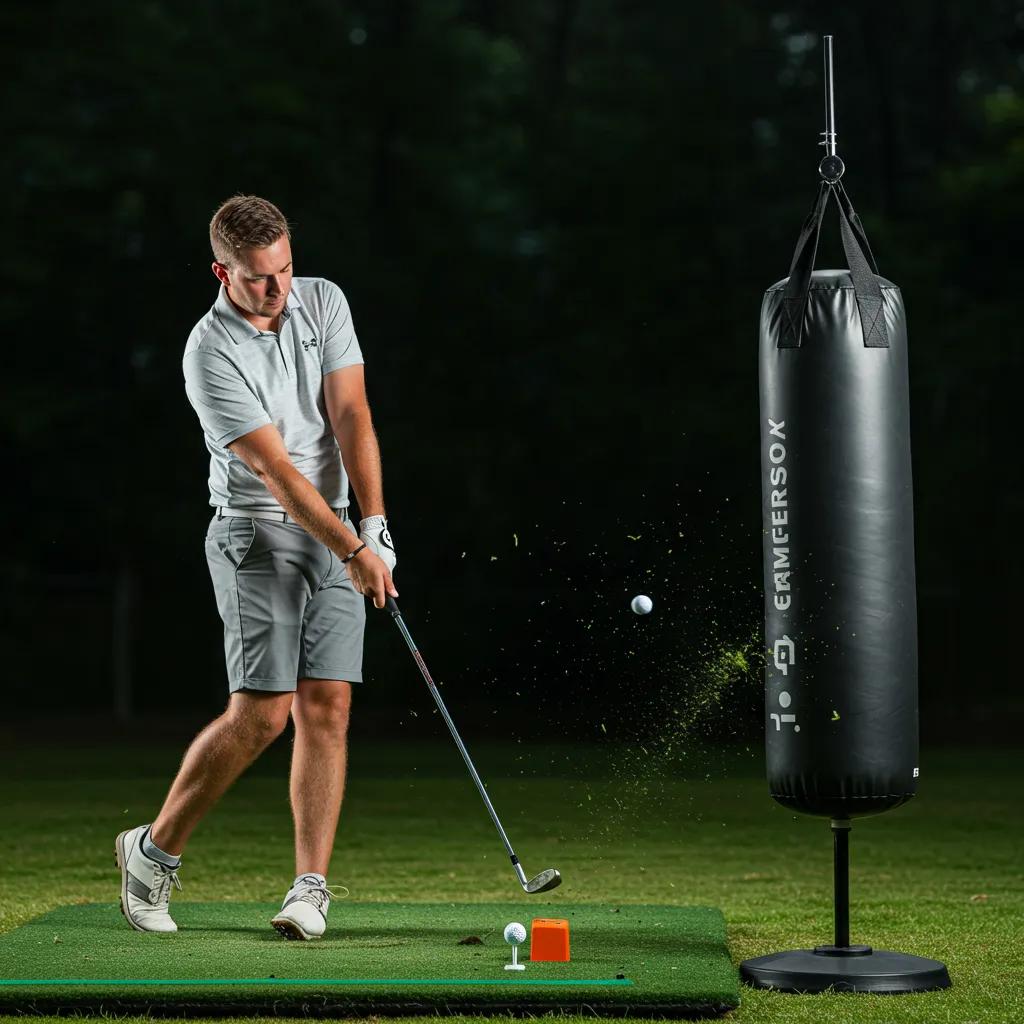
The impact bag drill trains forward shaft lean and impact compression by giving immediate tactile feedback at the moment of contact; striking the bag emphasizes a descending blow and solid compression that transfers energy efficiently to the ball. To execute, take a three-quarter swing and deliver the clubhead into the bag while maintaining a slightly forward shaft angle and holding the lead wrist firm through impact; focus on compressing rather than scooping. Safety guidance: use a soft, purpose-built impact bag and controlled speed to prevent strain; avoid overexertion in early sessions. Immediate cues—sound and feel—tell you whether impact is compressive and centered, making it easy to iterate rapidly and build consistent power while protecting accuracy.
This resource details the critical dynamics of golf impact and provides practical drills to help golfers achieve and consistently reproduce solid contact.
Mastering Golf Impact with Drills and Essential Dynamics
To further demonstrate these principles, Clampett presents photos and drills that convey the five essential dynamics golfers need to produce and reproduce solid impact.
The impact zone: Mastering golf’s moment of truth, 2024
Lag drills teach the feeling of delayed release where the wrist angle between shaft and lead arm is preserved into the downswing, creating a whip-like release that increases clubhead speed at impact. Useful drills include the pump drill—make a half backswing, pump to the top while holding the lag, then swing through—and paused drills that hold the top for a beat before initiating the downswing to emphasize the sequence. These drills are practiced in short sets to ingrain the sensation without losing control; measurable improvements show up as higher ball speed and longer carry when the release timing is correct. Combine lag work with tempo practice to ensure that increased distance does not come at the expense of directional accuracy.
Advanced-practice errors often stem from compensatory moves like early extension, casting the club (loss of lag), or a reverse pivot, each of which undermines power or accuracy by breaking the kinetic chain. Immediate corrective prescriptions include regressing to simpler drills—slow-motion sequencing, step-through weight-transfer, and impact bag repetitions—until the correct feel returns. Video analysis or coach feedback accelerates detection and correction by making small errors visible and measurable; revert to lower-speed practice when errors reappear under fatigue. Recognizing when to reduce intensity and rebuild the sequence is essential for sustainable gains and prevents reinforcing high-speed faults during power training.
Performance apparel enhances advanced training by reducing restriction, managing moisture, and preserving comfort during high-volume swings, allowing the athlete to focus solely on mechanics and power delivery. Fabrics with four-way stretch and breathable panels support full torso rotation and natural shoulder turn without binding, while moisture-wicking finishes pull sweat away from the skin to maintain grip and reduce distraction. Properly fitted polos and practice garments minimize fabric drag that can subtly alter swing timing, and durable seams withstand repetitive motion during extended sessions. Care guidance—wash on gentle cycles and avoid fabric softeners—preserves stretch and moisture management properties so clothing stays supportive through repeated training cycles.
Corrective drills target the root causes of directional faults—clubface angle at impact and swing path—so solutions are stable and repeatable. A slice typically results from an open clubface and an out-to-in path, while a hook often comes from a closed face and an inside-in path; identifying which combination applies is the first diagnostic step. Drills that re-pattern the path and face—such as gate drills, tee-pull exercises, and face-awareness short swings—help golfers reestablish a neutral connection between body rotation and club release. Training aids and gloves can support these drills by providing tactile feedback and stabilizing grip pressure, but they supplement technique work rather than replace it. The following subsections give targeted drills and guidance for tracking improvement.
Here are three corrective priorities to track progress:
Consistency in this progression reduces fault recurrence and restores confidence.
To fix a slice, focus on producing an inside-to-square-to-out path with a neutral clubface at impact; the swing path gate and alignment-stick inside-path drills are highly effective for this. The gate drill sets two tees or sticks slightly outside and inside the ball to force a shallower, inside approach through impact—practice slow swings until the club reliably clears the inside gate. Another helpful exercise is the body-rotation drill that emphasizes turning the hips and shoulders through impact rather than casting with the hands. Track improvement by observing reduced left-to-right curvature and more consistent distance, and regress to half-swings if the slice reappears under full effort. These drills build a repeatable path and better face control through structured repetitions.
Hook-fix drills rehearse a slightly more openface and controlled release to prevent an overly closed face at impact; tee-pull and alignment re-checks are practical starting points. In the tee-pull drill, place a tee ahead of the ball on the target line and practice swinging so that the clubhead passes the tee with a neutral-to-slightly-open face feel, emphasizing rotation that clears the hands through impact. Short-swing face-awareness drills—making three-quarter swings while focusing on the face position at the top and at impact—help the golfer learn to delay excessive forearm rotation that closes the face. Monitoring ball flight for reduced right-to-left curvature and stabilizing distance signals successful adjustment.
Training aids and gloves provide tactile and visual feedback that accelerates corrective learning by reducing variability in grip and making path/face errors more obvious during practice. Alignment sticks create reliable visual references for swing path and setup, impact bags emphasize compression and face position at contact, and lightweight tempo devices enforce rhythm. A consistent glove helps maintain consistent grip pressure so that changes in ball flight reflect technique rather than grip variation; gloves with moisture control support reliable contact during longer correction sessions. Integrate aids selectively—pair each drill with the single most relevant aid to avoid dependency—and remove them as the new pattern becomes stable.
Mechanics-focused drills isolate posture, swing plane, and clubface control to create a systematic approach to repeatable ball striking; each drill targets a measurable attribute so progress is observable. By separating posture setup, backswing/downswing sequencing, and impact orientation into discrete exercises, players can methodically eliminate sources of inconsistency. The Entity-Attribute-Value table below links biomechanical elements to practical cues and desired outcomes so golfers and coaches can prioritize drills based on the aspect that most affects consistency. Once individual mechanics improve, integrated swing drills reinforce the full movement with greater reliability and less compensatory action.
| Mechanical Element | Key Cue | Desired Outcome |
|---|---|---|
| Posture | Neutral spine and slight knee flex | Stable base and consistent swing plane |
| Backswing/Downswing Sequence | Smooth weight shift and hip rotation | Repeatable path and timing |
| Impact Position | Forward shaft lean and centered strike | Solid compression and predictable launch |
| Clubface Control | Square-to-target at impact | Consistent ball flight and dispersion control |
Understanding the biomechanics of golf is crucial for maximizing both distance and accuracy, involving principles like the kinetic link and ground reaction forces.
Biomechanics for Maximizing Golf Distance and Accuracy
Golf biomechanics applies the principles and technique of mechanics to the structure and function of the golfer in an effort to improve golf technique and performance. A common recommendation for technical correction is maintaining a single fixed centre hub of rotation with a two-lever one-hinge moment arm to impart force on the ball. The primary and secondary spinal angles are important for conservation of angular momentum using the kinetic link principle to generate high club-head velocity. When the golfer wants to maximise the distance of their drives, relatively large ground reaction forces (GRF) need to be produced. However, during the backswing, a greater proportion of the GRF will be observed on the back foot, with transfer of the GRF on to the front foot during the downswing/acceleration phase. Rapidly stretching hip, trunk and upper limb muscles during the backswing, maximising the X-factor early in the downswing, and uncocking the wrists when the lead arm is about 30° below the horizontal will take advantage of the summation of force principle. This will help generate large angular velocity of the club head, and ultimately ball displacement. Physical conditioning will help to recruit the muscles in the correct sequence and to optimum effect. To maximise the accuracy of chipping and putting shots, the golfer should produce a lower grip on the club and a slower/shorter backswing. Consistent patterns of shoulder and wrist movements and temporal patterning result in successful chip shots. Qualitative and quantitative methods are used to biomechanically assess golf techniques. Two- and three-dimensional videography, force plate analysis and electromyography techniques have been employed. The common golf biomechanics principles necessary to understand golf technique are stability, Newton’s laws of motion (inertia, acceleration, action reaction), lever arms, conservation of angular momentum, projectiles, the kinetic link principle and the stretch-shorten cycle
The role of biomechanics in maximising distance and accuracy of golf shots, PA Hume, 2005
Posture provides the structural platform from which all swing motions originate; a neutral spine, balanced knee flex, and appropriate hip tilt enable repeatable rotation and consistent swing plane. Posture drills—mirror checks, towel-under-armpits to maintain connection, and wall-posture holds—train proprioception so the address position becomes automatic. Poor posture introduces compensations such as early extension or a flat swing plane, which undermine other drills; correcting posture first reduces the noise in subsequent movement work. Regular posture validation during warm-up ensures that alignment, tempo, and weight-transfer drills operate from a stable base, accelerating durable improvements.
Backswing and downswing plane drills re-teach the correct arc of motion so the club moves on the intended path without over-the-top or excessively flat errors; alignment sticks or a visual rail provide immediate lane guidance. A slow, stepwise drill—take the backswing slowly to the top while checking plane, pause, then return on the same plane—helps the body feel the correct rotational sequence. Gradually increase speed while maintaining the plane until full swings replicate the same path, and use video feedback to confirm the plane across reps. Reinforcing plane consistency through these drills reduces lateral compensations and stabilizes contact patterns.
Clubface orientation at impact determines initial launch direction and spin, making face control perhaps the single most influential factor in shot outcome; small face errors produce disproportionate dispersion. Drills that isolate face feel—short swings focusing on impact, alignment-face checks, and impact bag repetitions—train tactile awareness and muscle memory for neutral face delivery. Measuring progress involves observing tighter dispersion patterns and reduced curvature magnitude in ball flight. Once face control improves in isolation, integrating it with tempo and weight-transfer drills ensures the face behaves predictably under full-speed conditions.
Scale Wear Design Co. produces golf gloves engineered for consistent grip and moisture management—features that reduce variability in hand pressure across repeated practice swings and help trainees feel true mechanical changes. Gloves with engineered palm textures and breathable materials maintain tack through sweat, enabling reliable tactile feedback during alignment, tempo, and impact drills. For practice sessions in variable conditions, the right glove reduces confounding grip issues so improvements reflect mechanics rather than equipment inconsistencies. Consider rotating gloves across sessions to prolong performance and maintain consistent fit; Scale Wear’s product range includes gloves suitable for practice and for wet-weather conditions.
Home and range practice should prioritize low-equipment drills that reinforce core mechanics while fitting into short daily routines. The split tennis ball drill, alignment checks, and tempo sets are portable exercises that require little space and produce measurable improvements when practiced in consistent short sessions. Below is a quick-reference table mapping drills to equipment and primary skills so players can choose drills that match their available resources. Short daily tempo work combined with two longer technical sessions per week produces steady progress without overloading the body. The following subsections give stepwise instructions for the most accessible drills.
| Drill | Equipment Needed | Primary Skill Practiced |
|---|---|---|
| Split Tennis Ball | Two tennis balls or rolled sock | Weight transfer and impact compression |
| Alignment Stick Drill | Club or alignment stick | Setup and swing path alignment |
| Tempo Metronome Drill | Phone metronome app | Rhythm and timing |
| Short Impact Bag Reps | Small impact bag or towel | Impact compression and face control |
The split tennis ball drill forces correct lateral and rotational movement by creating a narrow target between the feet or just behind the trail knee that the golfer must compress at impact-like moments. Set up with a tennis ball positioned between the feet or tucked near the trail thigh, make three-quarter swings at moderate speed aiming to feel pressure closing toward the lead side at the point where the ball would be compressed. Common errors include sliding or turning the hips too early; correct these by shortening the backswing and emphasizing sequence with a slow tempo. Progress by increasing swing length and integrating the established weight shift into full swings on the range.
Solo alignment drills use household items or clubs to create visual markers that verify feet, hips, and shoulder aim without a coach. Place a club on the ground pointing at the target to check your toe line, use a second stick parallel to your feet for shoulder alignment, and rehearse pre-shot checks in a 5–7 step routine to make setup automatic. For swing-path validation, set two tees or markers to create a gate and practice sweeping through the gate on slow swings until the motion feels consistent. These visual references provide instant, objective feedback that accelerates correction and keeps practice focused.
Short, daily tempo practice prevents timing regressions and is easy to integrate into warm-ups or busy schedules; aim for 3–5 minutes each day using a metronome app or a simple 3:1 count for backswing-to-downswing. Structure sessions into quick sets—four sets of eight swings—focusing solely on rhythm and relaxation rather than distance; this builds automatic timing that holds up under pressure. Track improvements by noting contact quality and ball flight consistency over time; small, frequent tempo practice yields better retention than infrequent long sessions. Once tempo is stable in short sets, add alignment or weight-transfer drills to compound benefits.
Scale Wear Design Co. offers accessories—gloves, towels, and small training aids—that support consistent home practice by reducing equipment-related variability and improving maintenance of training gains. A quality practice glove stabilizes grip pressure during repeated reps, an absorbent towel maintains tack and reduces slip, and compact alignment devices provide durable visual feedback for solo sessions. Choosing accessories with durable materials and easy-care instructions ensures they remain effective through frequent practice. For teams or academies seeking branded practice gear, Scale Wear also supports custom apparel and accessory orders to create consistent training kits for groups.
Performance golf apparel supports drill execution by providing mobility, moisture control, and durability that let players focus on mechanics without garment-related restrictions. Specific fabric technologies—moisture-wicking, four-way stretch, and ventilation panels—work through physical mechanisms: they manage sweat to preserve grip, allow full torso and shoulder rotation, and prevent overheating that can degrade motor control during long practice sessions. Properly chosen apparel therefore lowers non-technical noise in practice, enabling clearer feedback from drills and faster skill consolidation. The subsections below map apparel features to drill benefits and explore custom apparel options for teams and branded accessories.
Key apparel features that support drills include:
| Golf Glove | Grip technology & breathability | Consistent hand pressure and tactile feedback |
|---|---|---|
| Performance Polo | Moisture-wicking & stretch | Unrestricted rotation and temperature control |
| Golf Towel | High absorbency & loop attachment | Maintain grip and quick cleanup between reps |
Golf gloves matter because they stabilize the interface between hand and club, controlling grip pressure and preserving tactile feedback that informs clubface awareness; materials and fit determine how effectively they perform. Synthetic blends often offer superior moisture resistance and durability for heavy practice, while leather provides unmatched feel in dry conditions; the choice depends on the practice environment. Proper fit—snug but not constrictive—prevents bunching that can alter grip mechanics, and breathable panels reduce sweat accumulation. Regular inspection and replacement maintain consistent tactile conditions so drill feedback remains meaningful over time.
Moisture-wicking polos pull sweat away from the skin to the fabric surface where it evaporates, keeping the torso dry and reducing friction between garment and skin that can constrain motion. Paired with four-way stretch, these fabrics enable unobstructed shoulder and torso rotation that is essential for accurate swing sequencing during tempo and power drills. Staying dry also reduces distraction and the tendency to alter grip pressure, which improves repeatability across long practice sessions. Care—washing on gentle cycles and avoiding fabric softeners—helps preserve moisture-management and stretch properties over the garment’s life.
Custom team apparel creates uniform performance standards across squads and academies, aligning mobility, moisture management, and visual identity so players train in consistent gear that supports mechanics and morale. Bulk customization streamlines procurement and ensures each athlete uses garments engineered for training rather than mixed consumer options, simplifying maintenance and replacement. For academies, branded practice apparel promotes cohesion and provides a reproducible equipment baseline, reducing variability that can obscure technique progress. For groups interested in custom orders, Scale Wear Design Co. offers tailored options to outfit teams with performance-focused polos, gloves, and accessories.
Branded towels and small accessories serve practical purposes—grip maintenance, quick ball and club cleaning, and alignment markers—while reinforcing team identity in organized training settings. Towels designed for high absorbency and secure attachment points keep hands and grips dry between reps, and compact markers provide durable visual guides for solo alignment drills. For teams and events, branding on towels and accessories strengthens cohesion and simplifies kit distribution. Choosing durable, quick-dry materials extends product life and ensures accessories remain functional through frequent practice cycles.
Golfers frequently ask which drill delivers the fastest improvement, how gloves help, whether drills can fix structural faults, and how often to practice; concise, evidence-informed answers help set realistic expectations and structure practice. Drills can produce rapid feel changes in baseline mechanics, but durable improvement depends on consistent, progressive practice with measurable feedback. Below are succinct answers that target featured snippet and PAA-style queries, each followed by a short expansion and pointer to the relevant section for deeper guidance.
The alignment drill is the most impactful single beginner exercise because consistent setup underpins path and face control; practicing alignment reduces compensatory errors in tempo and weight transfer. Short daily alignment checks—paired with tempo sets—yield the fastest early improvement in contact and direction. For detailed setup steps and progression, refer to the alignment subsection above where setup, common mistakes, and practice progressions are explained.
Golf gloves promote consistent grip pressure and reduce variability caused by sweat or hand movement, enabling more reliable tactile feedback that reveals true technique changes during drills. Gloves with moisture-wicking palms and flexible backs allow natural wrist hinge and help maintain the same hand feel across reps. For product specifics and when to use different glove types, see the sections on glove features and Scale Wear glove recommendations.
Yes—drills can significantly reduce slices and hooks by isolating the root cause (face angle or path) and retraining the required movement pattern; success requires accurate diagnosis and consistent, focused practice. Use targeted gate, alignment, and face-awareness drills first, then progress to tempo and full-swing validation to ensure stability. Persistent problems or structural movement patterns may warrant coach analysis or video feedback.
Aim for short daily tempo or alignment practice (5 minutes) with two to three longer focused sessions per week (20–40 minutes) that isolate mechanics or power work; this cadence balances neural consolidation with recovery. Track progress with measurable markers—ball flight dispersion, contact quality, and video analysis—and regress intensity when errors increase under fatigue. Consistency beats volume: regular, deliberate practice accelerates reliable improvement.
Training aids enhance practice by providing immediate feedback on swing mechanics, helping golfers identify and correct errors in real-time. Tools like alignment sticks, impact bags, and tempo devices can reinforce proper techniques, making it easier to develop muscle memory. They also create visual and tactile cues that guide golfers through complex movements, ensuring that practice is both effective and efficient. By integrating these aids into drills, players can accelerate their learning curve and achieve more consistent results on the course.
Measuring progress in golf swing drills can be achieved through various methods, including tracking ball flight patterns, recording swing speed, and using video analysis. Keeping a practice journal to note improvements in contact quality, distance, and accuracy can also provide valuable insights. Additionally, utilizing technology like launch monitors can offer precise data on swing mechanics and performance metrics. Regularly assessing these factors helps golfers identify areas for improvement and adjust their practice routines accordingly.
Mental focus is crucial in executing golf swing drills effectively. Concentration helps golfers internalize the mechanics of their swings, allowing them to replicate movements consistently. Visualization techniques can enhance performance by enabling players to mentally rehearse their swings before executing them. Additionally, maintaining a positive mindset during practice can reduce anxiety and improve overall performance. Incorporating mindfulness or breathing exercises can further enhance focus, leading to more productive practice sessions and better results on the course.
Incorporating golf swing drills into a busy schedule can be achieved by prioritizing short, focused practice sessions. Aim for 5-10 minutes of daily drills that target specific skills, such as alignment or tempo. Utilize downtime, such as waiting for a tee time or during breaks, to practice visualization or perform simple movements. Additionally, consider combining drills with regular fitness routines to maximize time efficiency. Consistency is key, so even brief, regular practice can lead to significant improvements over time.
Frustration during practice is common, especially when progress seems slow. To manage this, take breaks to reset your mindset and avoid burnout. Focus on specific aspects of your swing rather than trying to fix everything at once. Setting realistic goals and celebrating small achievements can also help maintain motivation. If frustration persists, consider seeking feedback from a coach or experienced golfer to gain new perspectives and techniques. Remember, improvement takes time, and patience is essential in the learning process.
Yes, improving your short game is essential for overall golf performance, and there are specific drills that can complement swing drills. Focus on chipping and putting drills that emphasize touch and accuracy, such as the ladder drill for chipping or the gate drill for putting. Incorporating these into your practice routine can enhance your feel for the club and improve your scoring ability. Regularly practicing short game drills alongside swing drills ensures a well-rounded skill set that translates to better performance on the course.
James Haworth is the co-founder of Scale Wear Design, a family-owned apparel brand built alongside his wife, Lisa. With roots in the fishing industry, James launched multiple successful brands before expanding into performance apparel, creating high-quality gear without the traditional retail markup. Under his leadership, Scale Wear has grown rapidly, offering golf, football, fishing, and lifestyle apparel while partnering with brands nationwide. Passionate about innovation and giving back, James has helped raise over $2 million for charities supporting veterans, first responders, and communities across the country.
Before you leave, use code ‘GOLF‘ at checkout
swing consistency drills, golf swing drills for distance and accuracy, golf swing mechanics drills